
Pentecost (Season)
The season after Pentecost, according to the calendar of the church year (BCP, p. 32). It begins on the Monday following Pentecost, and continues through most of the summer and autumn. It may include as many as twenty-eight Sundays, depending on the date of Easter. This includes Trinity Sunday which is the First Sunday after Pentecost. The BCP provides proper collects and readings for the other Sundays of the season. These propers are numbered and designated for use on the Sundays which are closest to specific days in the monthly calendar, whether before or after. For example, Proper 3 is designated for use, if needed, on the Sunday closest to May 25. Proper 29 is designated for use on the Sunday closest to Nov. 23. Prior to the 1979 BCP, Sundays in this long period of the church year were identified and counted in terms of the number of Sundays after Trinity Sunday instead of the number of Sundays after Pentecost. This period is also understood by some as “ordinary time,” a period of the church year not dedicated to a particular season or observance, as in the Roman Rite adapted after Vatican II. See Ordinary Time.
Episcopal Church Glossary
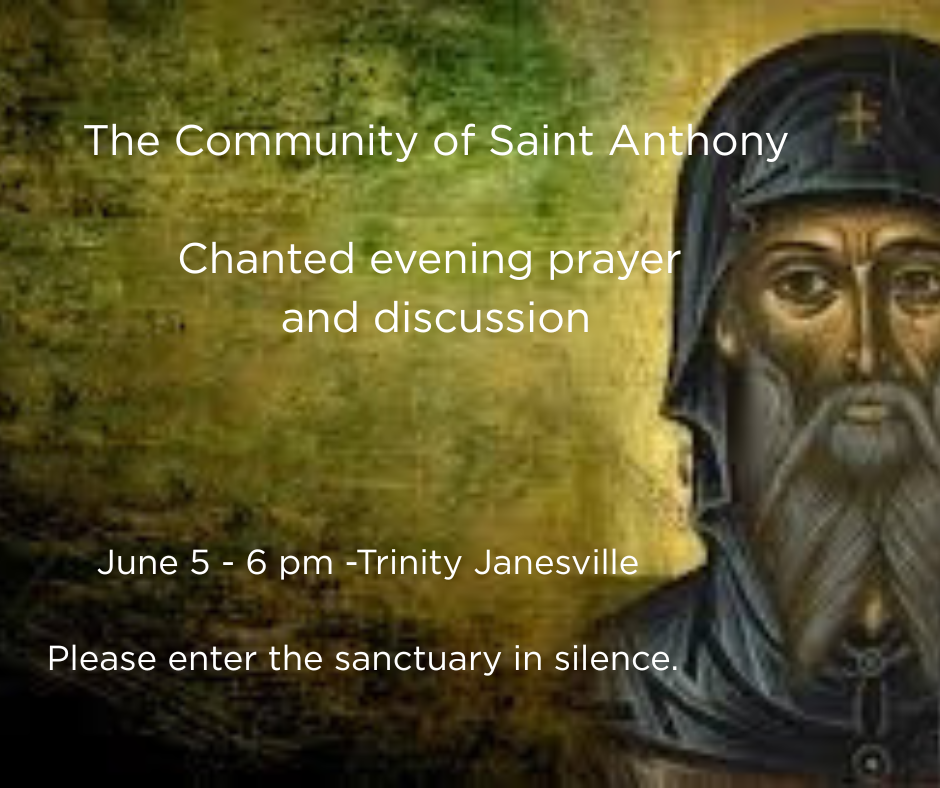
The Community of St Anthony.
My beloved sisters and brothers in Christ, in March I started a new ministry called The Community of St Anthony. It is a shared ministry between St Paul’s and Trinity. However, it is open to people outside of our parishes as well. A handful of people in the wider community have already expressed interest.
The central focus of this new ministry is spiritual formation. I want to provide an opportunity for people to go deeper in prayer alongside others. To that end, members of the group will embrace a threefold spiritual rule of life: continual recollection, fasting, and prayer for one’s enemies.
Continual recollection, as it is called in our tradition, is known by a few other names: unceasing prayer, meditation, the practice of the presence of God, wakefulness, things like that. In essence, we are going to learn how to turn all of life into prayer. We are going to learn the art of continually re-collecting ourselves before God, thus the name, continual recollection.
When it comes to fasting, I am going to ask people to slowly work their way up to the Episcopal Church’s more than reasonable, incredibly accessible, easily customizable, fasting practice. The Episcopal Church is a tradition of moderation, and we have a lot to offer to a world that no longer knows how to locate the middle ground between gluttony and self-mortification. Fasting is not so much a dietary practice, as much as it is a way of life.
Lastly, I am going to invite every member of the group to pray for their enemies, daily. Praying for one’s enemies is one of the most powerful things you will ever do. If we all spent more time praying for each other instead of villainizing each other, the world would be a much better place.
In addition to the practices of continual recollection, fasting, and praying for one’s enemies, the group will meet in-person on the first Friday night of every month at 6pm. The focus of these gatherings will be prayer and mutual encouragement. We will alternate between the two parishes for these in-person gatherings. One month we’ll be at St Paul’s, the next month we’ll be at Trinity, and so forth.
We will officially launch this new ministry on Friday night, March 6th at 6pm during our first in-person gathering at St Paul’s.
If any of this piques your interest, please plan on attending one of these info meetings.
Christ in our midst,
Fr TJ

GIFTS started at Trinity and over the years grew to a point where they have a beautiful setting for unhoused males. Trinity serves the ministry throughout the year but for two weeks, twice per year, we partner with First Lutheran church in a joint ministry of service.
Advent
The first season of the church year, beginning with the fourth Sunday before Christmas and continuing through the day before Christmas. The name is derived from a Latin word for “coming.” The season is a time of preparation and expectation for the coming celebration of our Lord's nativity, and for the final coming of Christ “in power and glory.”
Episcopal Church Glossary
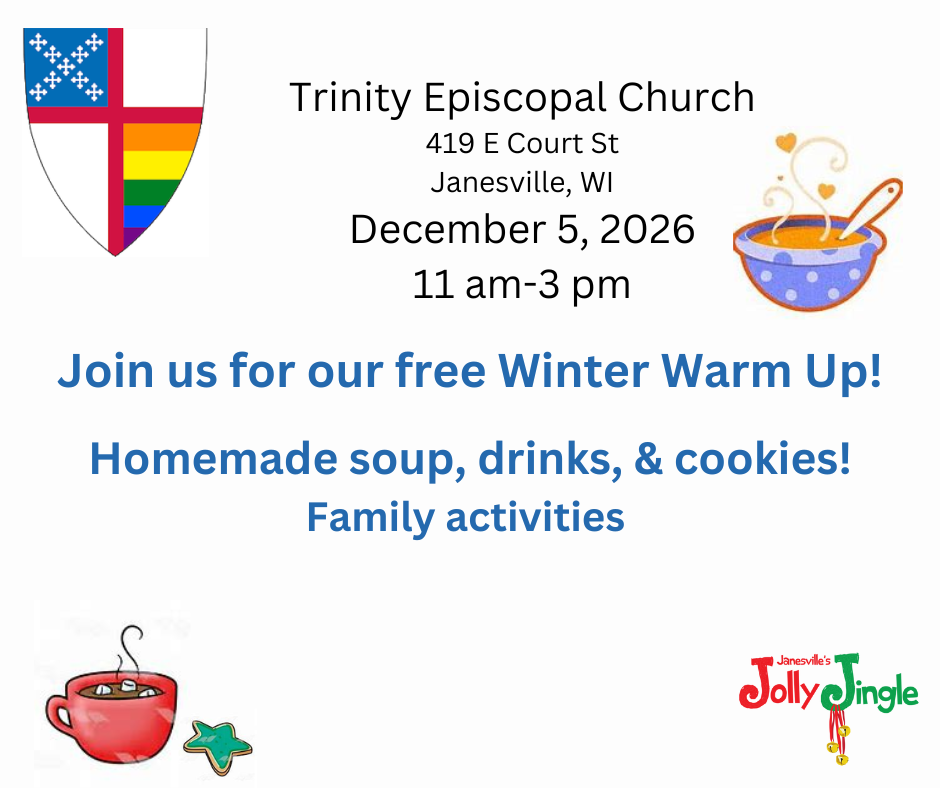
A favorite tradition during Janesville Jolly Jingle, and at the right price - FREE!
The food and drink are delicious and made with love. We offer a variety of soups with varying dietary options (while they last.) Our warm and inviting Parish Hall is decked out for fun.
Ortmayer Hall is located on the corner of East Court Street and Atwood Avenue. An accessible entrance with elevator is located on the side of the building on Atwood Ave - clearly marked.
Happy people from the wider community have been making this stop a tradition for years. The Trolley will stop (you have to ask), so don’t worry about weather or Court St. Hill. If you’re driving, parking is available in the Atwood Avenue parking lot.
Yum! Yum! Yum!
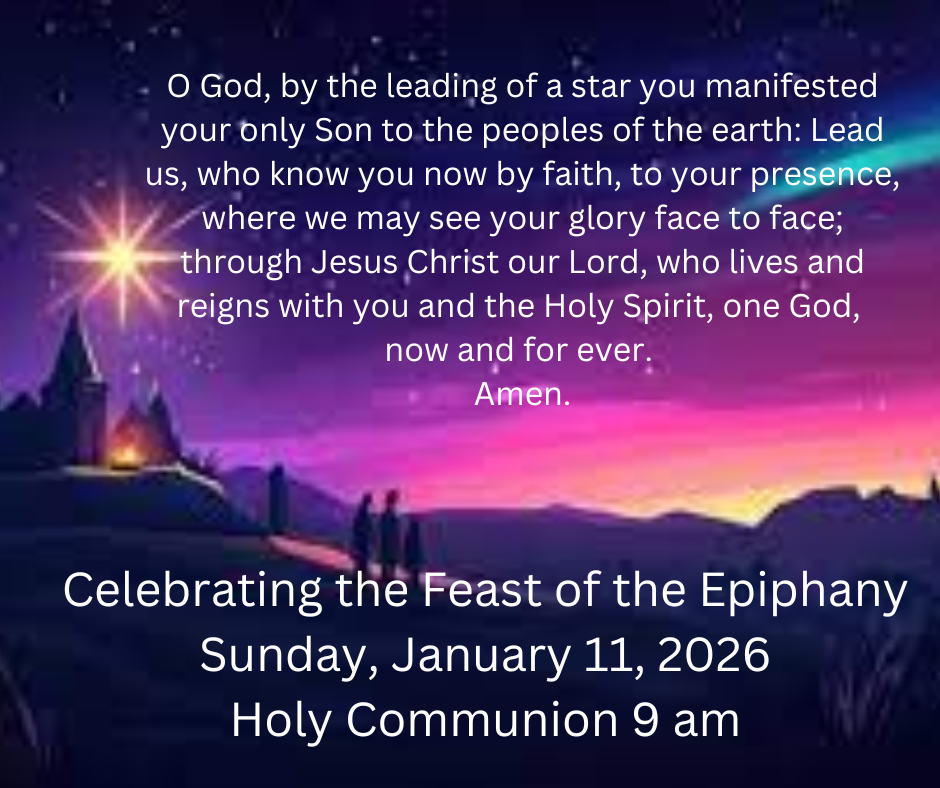
Epiphany
The manifestation of Christ to the peoples of the earth. The winter solstice was kept on Jan. 6 at some places during the first centuries of the Christian Era. In opposition to pagan festivals, Christians chose this day to celebrate the various manifestations, or "epiphanies," of Jesus' divinity. These showings of his divinity included his birth, the coming of the Magi, his baptism, and the Wedding at Cana where he miraculously changed water into wine. The day was called "The Feast of Lights." Celebration of the Son of God replaced celebration of the sun. Baptisms were done, and a season of preparation was instituted. It was later called Advent.
The solstice was kept on Dec. 25 by the fourth century. Jesus' birth was celebrated on this day in both eastern and western churches. The western church commemorated the coming of the Magi on Jan. 6. The eastern church continued to celebrate the Baptism of our Lord and the Wedding at Cana on Jan. 6. In the east the day was called "Theophany" (manifestation of God).
The coming of the Magi is celebrated on the Feast of the Epiphany, Jan. 6, in the BCP. The Baptism of our Lord is celebrated on the First Sunday after the Epiphany.
The Episcopal Church Glossary
Ash Wednesday
The first of the forty days of Lent, named for the custom of placing blessed ashes on the foreheads of worshipers at Ash Wednesday services. The ashes are a sign of penitence and a reminder of mortality, and may be imposed with the sign of the cross. Ash Wednesday is observed as a fast in the church year of the Episcopal Church. The Ash Wednesday service is one of the Proper Liturgies for Special Days in the BCP (p. 264).
Episcopal Church Glossary
Everyone is welcome to receive the imposition of ashes.
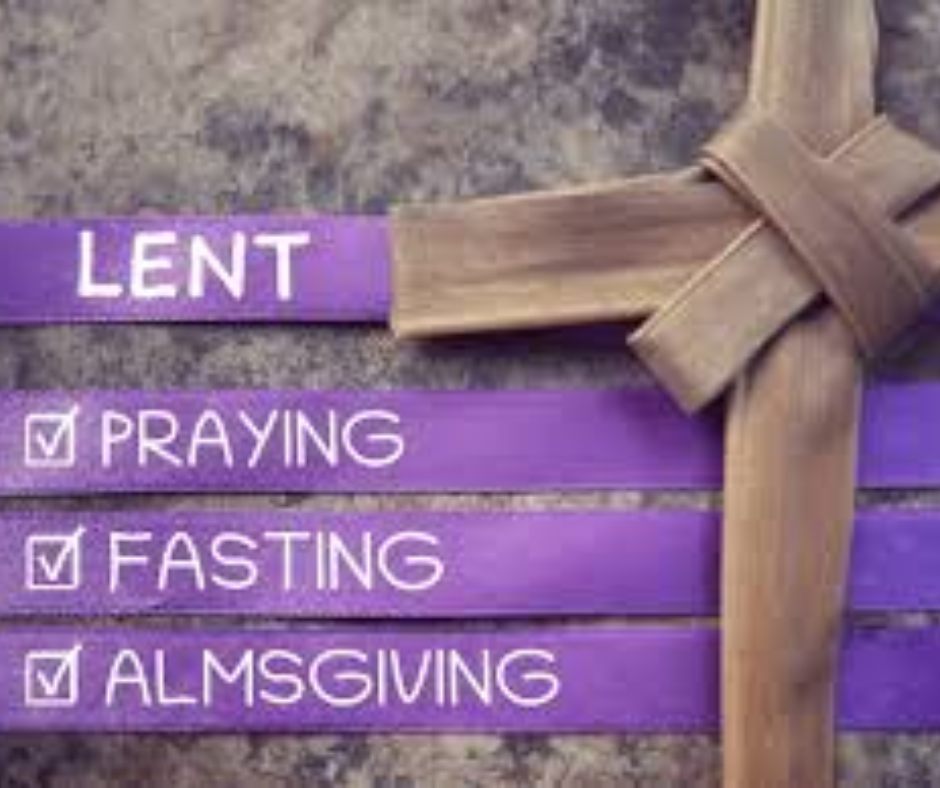
Lent
Early Christians observed “a season of penitence and fasting” in preparation for the Paschal feast, or Pascha (BCP, pp. 264-265). The season now known as Lent (from an Old English word meaning “spring,” the time of lengthening days) has a long history. Originally, in places where Pascha was celebrated on a Sunday, the Paschal feast followed a fast of up to two days. In the third century this fast was lengthened to six days. Eventually this fast became attached to, or overlapped, another fast of forty days, in imitation of Christ's fasting in the wilderness. The forty-day fast was especially important for converts to the faith who were preparing for baptism, and for those guilty of notorious sins who were being restored to the Christian assembly. In the western church the forty days of Lent extend from Ash Wednesday through Holy Saturday, omitting Sundays. The last three days of Lent are the sacred Triduum of Maundy Thursday, Good Friday, and Holy Saturday. Today Lent has reacquired its significance as the final preparation of adult candidates for baptism. Joining with them, all Christians are invited “to the observance of a holy Lent, by self-examination and repentance; by prayer, fasting, and self-denial; and by reading and meditating on God's holy Word” (BCP, p. 265).
Episcopal Church Glossary

Holy Week
From early times Christians have observed the week before Easter as a time of special devotion. As the pilgrim Egeria recorded in the late fourth century, Jerusalem contained many sacred places that were sites for devotion and liturgy. Numerous pilgrims to the holy city followed the path of Jesus in his last days. They formed processions, worshipped where Christ suffered and died, and venerated relics. From this beginning evolved the rites we observe today on Palm Sunday, Maundy Thursday, Good Friday, and Holy Saturday. These services provide a liturgical experience of the last days of Jesus' earthly life, as well as the time and events leading up to his resurrection. The BCP provides special liturgies for each of these days. The eucharistic lectionary also provides proper readings for Monday, Tuesday, and Wednesday in Holy Week. Some parishes observe the service of Tenebrae on one of these days in Holy Week. In many dioceses, the diocesan clergy will make a reaffirmation of ordination vows in the context of a eucharist during Holy Week, usually before Maundy Thursday. The three holy days, or Triduum, of Maundy Thursday, Good Friday, and Holy Saturday are at the heart of the Holy Week observance. In many Episcopal parishes, the liturgical color for Holy Week from Palm Sunday through Maundy Thursday is red. Holy Week ends at sundown on the Saturday before Easter, or with the celebration of the Easter Vigil.
Episcopal Church Glossary
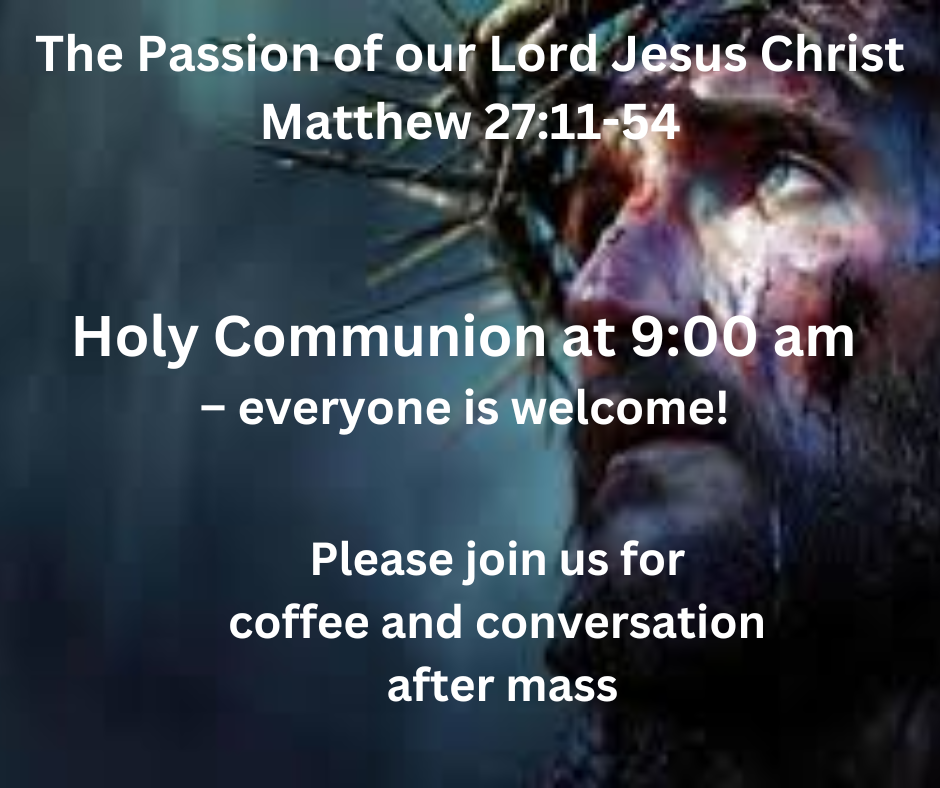
Palm Sunday (The Sunday of the Passion)
The Sunday before Easter at which Jesus’ triumphal entry into Jerusalem (Mt 21:1-11, Mk 11:1-11a, Lk 19:29-40) and Jesus’ Passion on the cross (Mt 26:36-27:66, Mk 14:32-15:47, Lk 22:39-23:56) are recalled. It is also known as the Sunday of the Passion. Palm Sunday is the first day of Holy Week. Red is the liturgical color for the day. The observance of Palm Sunday in Jerusalem was witnessed by the pilgrim Egeria in about 381-384. During this observance there was a procession of people down the Mount of Olives into Jerusalem. The people waved branches of palms or olive trees as they walked. They sang psalms, including Ps 118, and shouted the antiphon, “Blessed is he who comes in the name of the Lord!” The Palm Sunday observance was generally accepted throughout the church by the twelfth century. However, the day was identified in the 1549 BCP as simply “The Sunday next before Easter.” The blessing of branches and the procession were not included. The 1928 BCP added the phrase “commonly called Palm Sunday” to the title of the day. A form for blessing palms was provided by the Book of Offices (1960). The 1979 BCP presents the full title for the day, “The Sunday of the Passion: Palm Sunday” (BCP, p. 270). The liturgy of the palms is the entrance rite for the service. The congregation may gather at a place apart from the church and process to the church after the blessing of the branches of palm or other trees (BCP, p. 270). The liturgy of the palms includes a reading of one of the gospel accounts of Jesus’ entrance into Jerusalem. The branches may be distributed to the people before the service or after the prayer of blessing. All the people hold branches in their hands during the procession. Appropriate hymns, psalms, or anthems are sung.
Episcopal Church Glossary
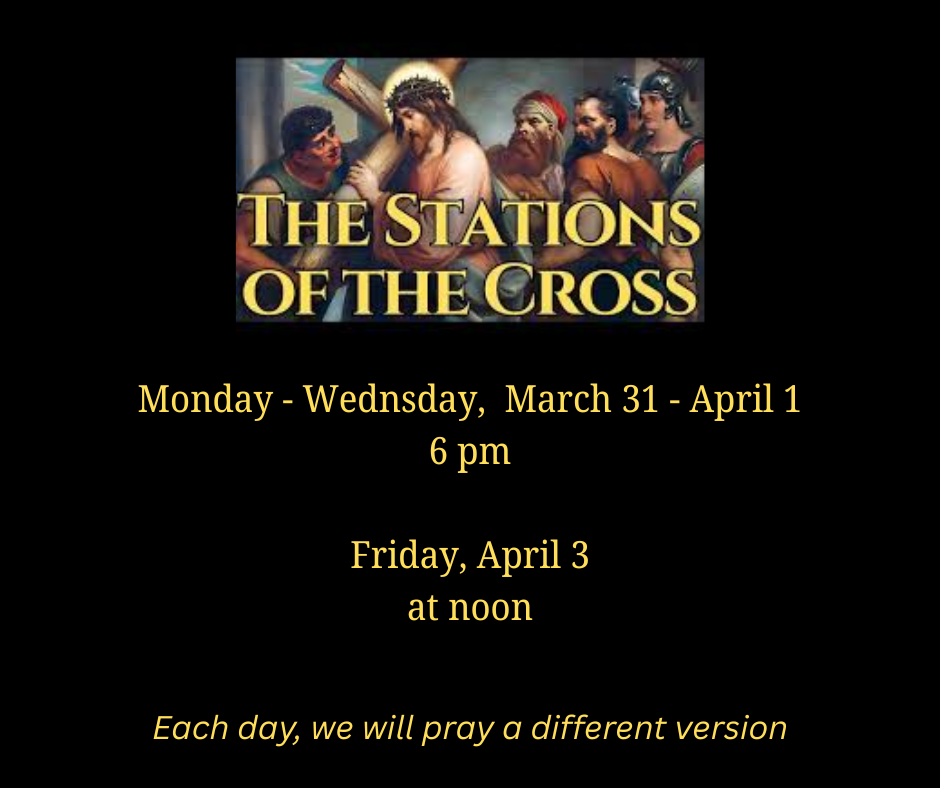
Way of the Cross (Stations of the Cross)
A devotion to the Passion of Christ which recalls a series of events at the end of Jesus' life from his condemnation to his burial. The Way of the Cross imitates the practice of visiting the places of Jesus' Passion in the Holy Land by early Christian pilgrims. The first stations outside Palestine were built in Bologna in the fifth century. This devotion was encouraged by the Franciscans, and it became common in the fifteenth century. The number of stations for prayer and meditation in the Way of the Cross has varied, but it typically includes fourteen stations. Each station may have a cross and an artistic representation of the scene. The stations may be erected inside a church or outdoors. The BOS includes the following stations in the Way of the Cross: 1) Jesus is condemned to death; 2) Jesus takes up his cross; 3) Jesus falls the first time; 4) Jesus meets his afflicted mother; 5) the cross is laid on Simon of Cyrene; 6) a woman wipes the face of Jesus; 7) Jesus falls a second time; 8) Jesus meets the women of Jerusalem; 9) Jesus falls a third time; 10) Jesus is stripped of his garments; 11) Jesus is nailed to the cross; 12) Jesus dies on the cross; 13) the body of Jesus is placed in the arms of his mother; 14) Jesus is laid in the tomb. The BOS notes that eight of the stations are based on events that are recorded in the gospels. The remaining six (stations 3, 4, 6, 7, 9, 13) are based on inferences from the gospels or pious legends. The BOS allows these six stations to be omitted from the Way of the Cross. The BOS provides opening devotions and the Lord's Prayer. There is a versicle and response, a reading, a prayer, and a collect for each of the fourteen stations. Concluding prayers before the altar follow the fourteenth station in the BOS service. The hymn Stabat Mater has been associated with the Way of the Cross. Verses of this hymn traditionally have been sung between each of the stations when the devotion is done by a congregation. The Stabat Mater appears as “At the cross her vigil keeping,” Hymn 159 in The Hymnal 1982. The BOS suggests that verses of this hymn be sung as the ministers enter for the Way of the Cross and as they approach the first station. The BOS also suggests that the Trisagion be chanted as the procession goes from station to station.
Episcopal Church Glossary
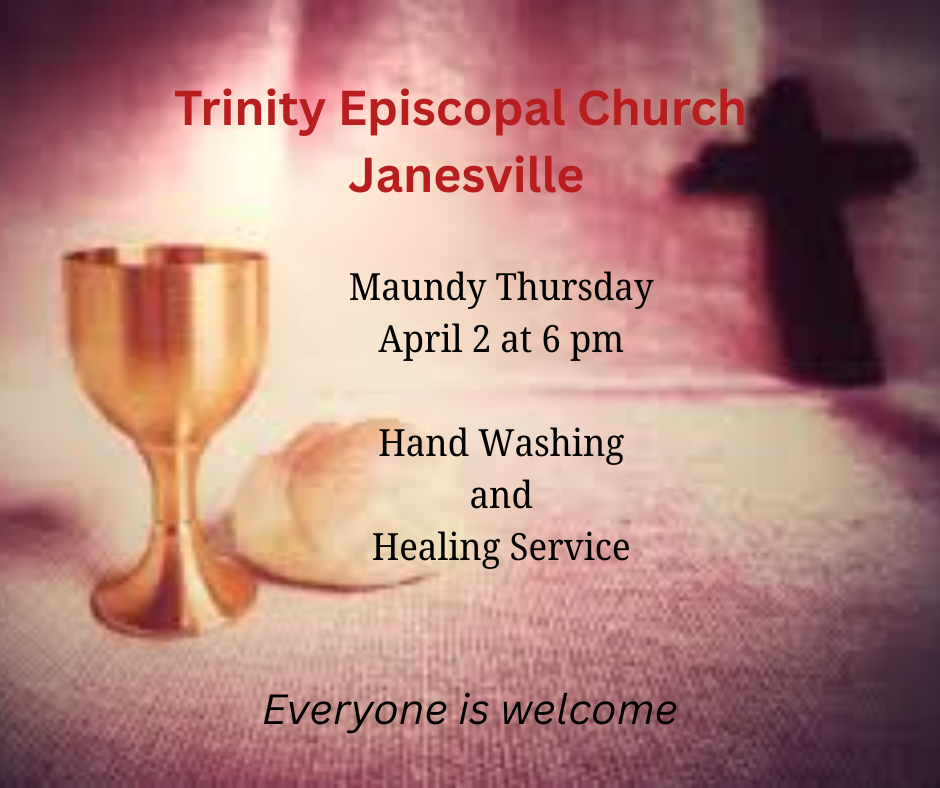
Maundy Thursday
The Thursday in Holy Week. It is part of the Triduum, or three holy days before Easter. It comes from the Latin mandatum novum, “new commandment,” from Jn 13:34. The ceremony of washing feet was also referred to as “the Maundy.” Maundy Thursday celebrations also commemorate the institution of the eucharist by Jesus “on the night he was betrayed.” Egeria, a fourth-century pilgrim to Jerusalem, describes elaborate celebrations and observances in that city on Maundy Thursday. Special celebration of the institution of the eucharist on Maundy Thursday is attested by the Council of Hippo in 381. The Prayer Book liturgy for Maundy Thursday provides for celebration of the eucharist and a ceremony of the washing of feet which follows the gospel and homily. There is also provision for the consecration of the bread and wine for administering Holy Communion from the reserved sacrament on Good Friday. Following this, the altar is stripped and all decorative furnishings are removed from the church.
Episcopal Church Glossary
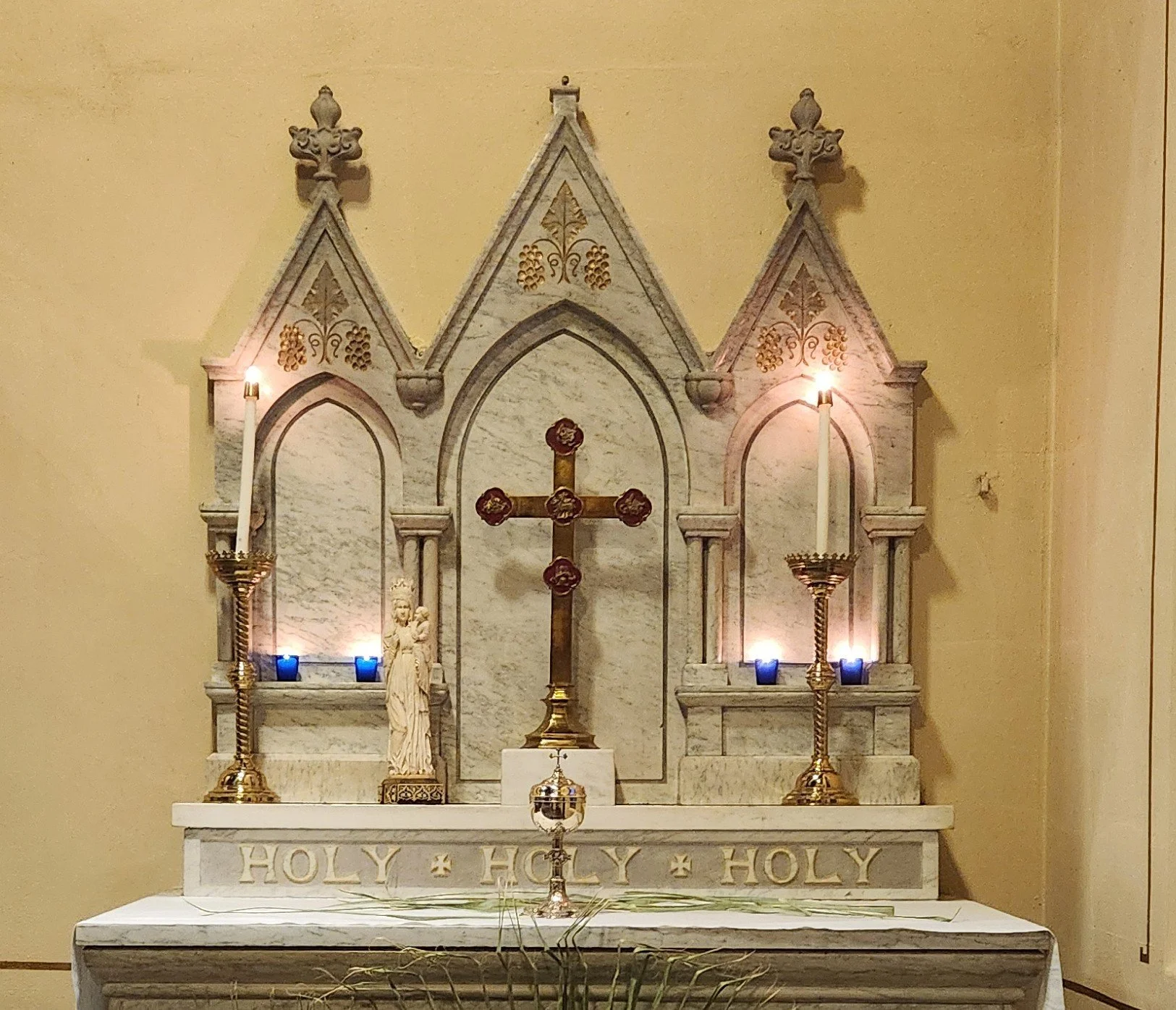
Trinity welcomes you to join our Prayer Vigil on Good Friday from
9 am until noon.
Altar of Repose
An altar other than the main altar of the parish upon which the consecrated bread and wine from the Maundy Thursday eucharist are reserved for communion on Good Friday. The altar of repose may be in a chapel or a room away from the church. It is usually decorated with candles and flowers. Members of the congregation may participate in a watch or vigil at the altar of repose from the conclusion of the Maundy Thursday service until the beginning of the Good Friday service.
Episcopal Church Glossary
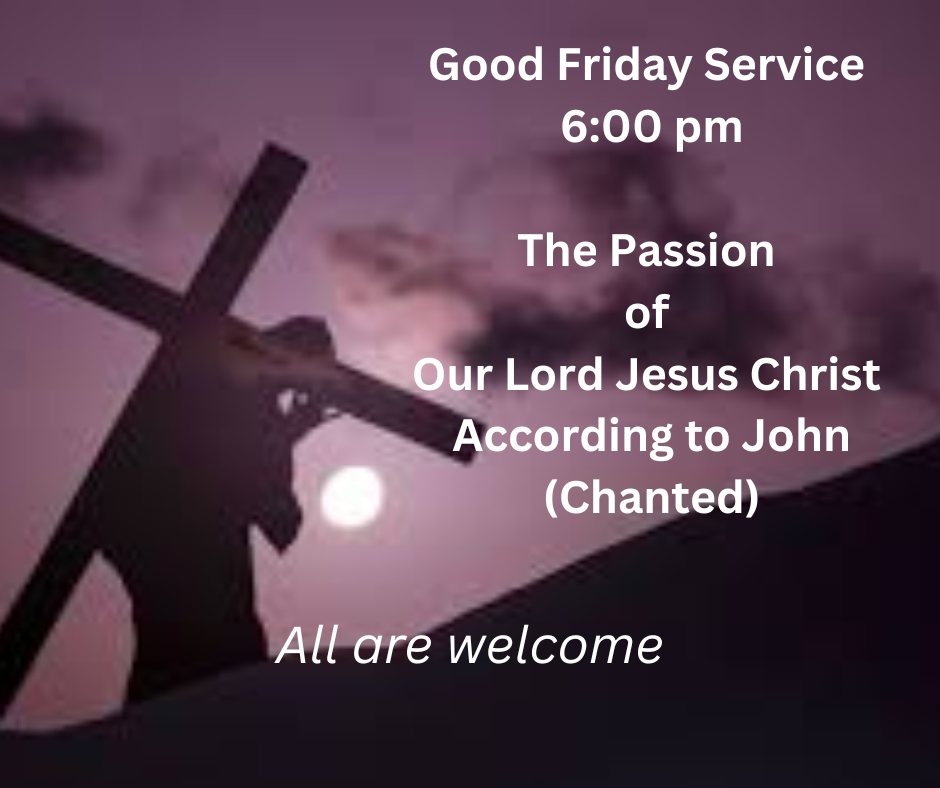
Good Friday
The Friday before Easter Day, on which the church commemorates the crucifixion of Jesus. It is a day of fasting and special acts of discipline and self-denial. In the early church candidates for baptism, joined by others, fasted for a day or two before the Paschal feast. In the west the first of those days eventually acquired the character of historical reenactment of the passion and death of Christ. The liturgy of the day includes John's account of the Passion gospel, a solemn form of intercession known as the solemn collects (dating from ancient Rome), and optional devotions before the cross (commonly known as the veneration of the cross). The eucharist is not celebrated in the Episcopal Church on Good Friday, but Holy Communion may be administered from the reserved sacrament at the Good Friday service.
Episcopal Church Glossary
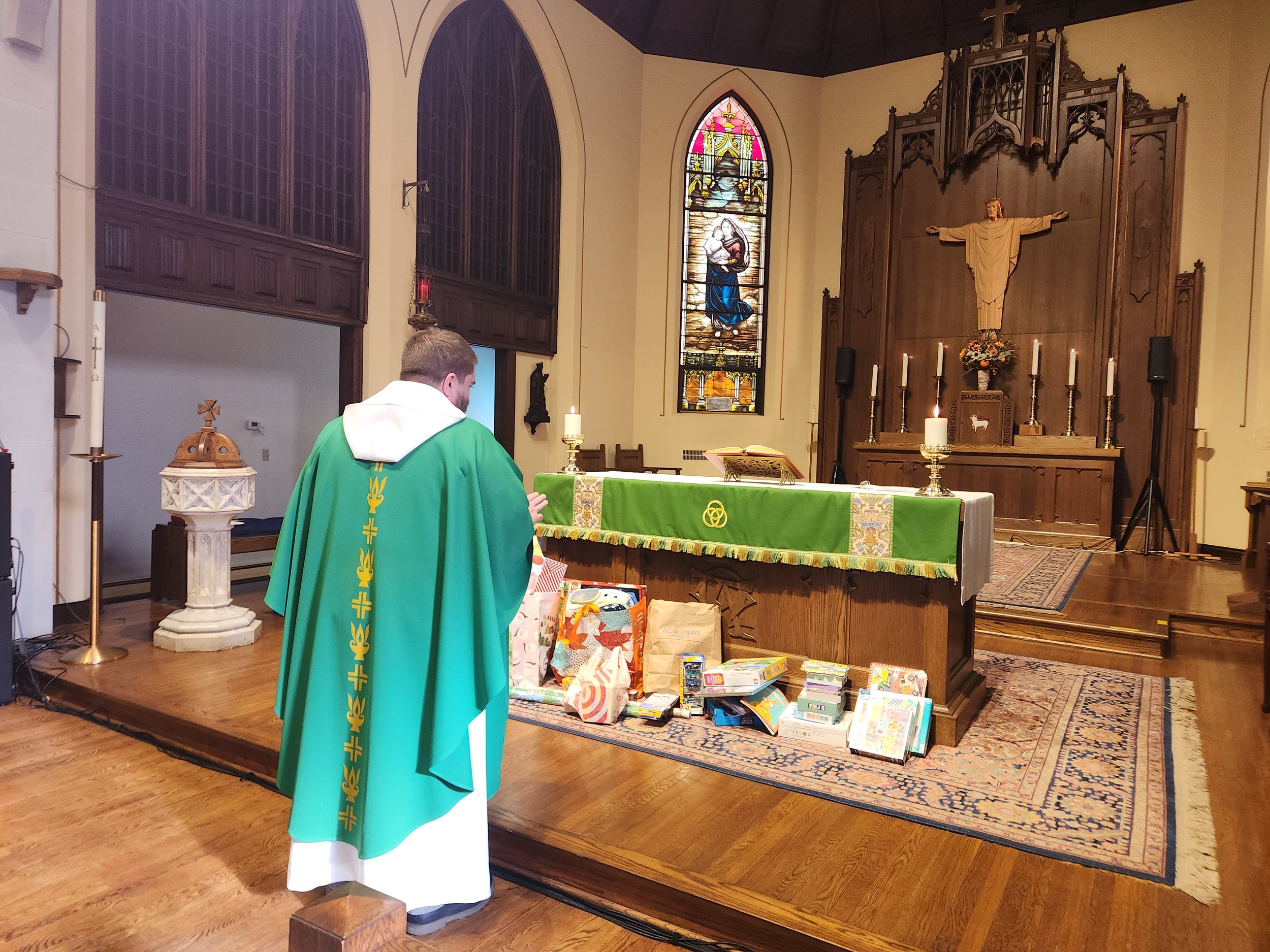
Thank you to everyone who donated gifts for Jail Chaplaincy. Rev. TJ Humphrey blessed the gifts on Sunday, November 16, 2025.
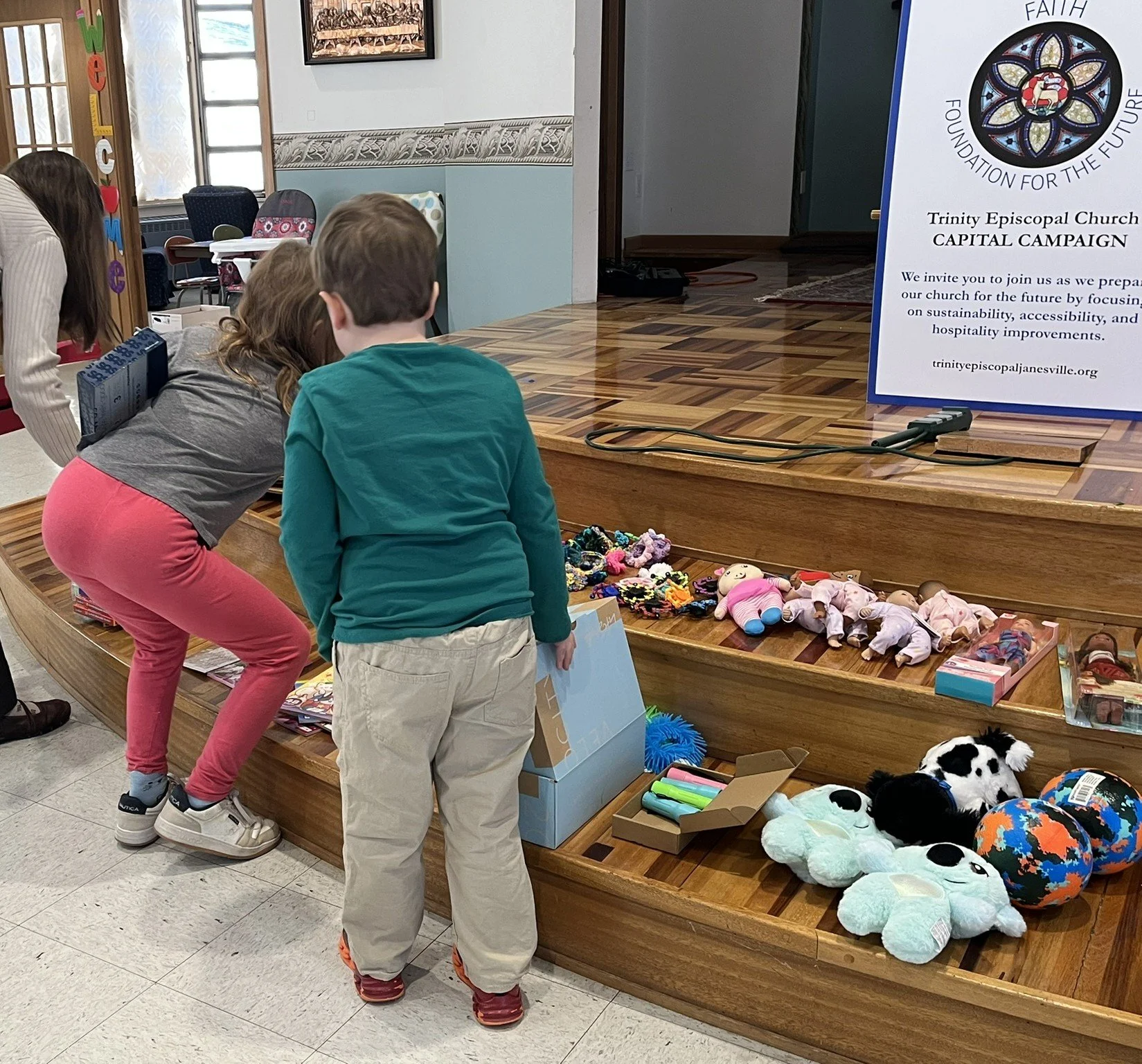
Our Children’s Faith Formation collected various items and packaged Christmas boxes for children on Sunday, November 16, 2025.

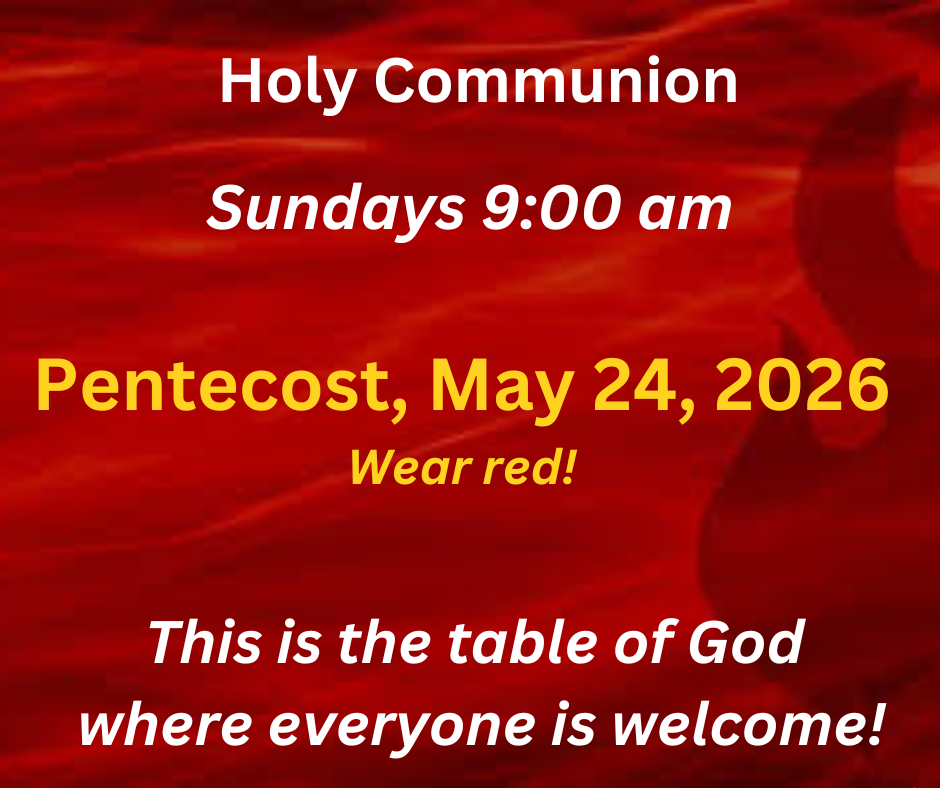
Pentecost
The term means “the fiftieth day.” It is used in both the OT and the NT. In the OT it refers to a feast of seven weeks known as the Feast of Weeks. It was apparently an agricultural event that focused on the harvesting of first fruits. Josephus referred to Pentecost as the fiftieth day after the first day of Passover. The term is used in the NT to refer to the coming of the Spirit on the day of Pentecost (Acts 2:1), shortly after Jesus' death, resurrection, and ascension. Christians came to understand the meaning of Pentecost in terms of the gift of the Spirit. The Pentecost event was the fulfillment of a promise which Jesus gave concerning the return of the Holy Spirit. The speaking in tongues, which was a major effect of having received the Spirit, is interpreted by some to symbolize the church's worldwide preaching. In the Christian tradition, Pentecost is now the seventh Sunday after Easter. It emphasizes that the church is understood as the body of Christ which is drawn together and given life by the Holy Spirit. Some understand Pentecost to be the origin and sending out of the church into the world. The Day of Pentecost is one of the seven principal feasts of the church year in the Episcopal Church (BCP, p. 15). The Day of Pentecost is identified by the BCP as one of the feasts that is “especially appropriate” for baptism (p. 312). The liturgical color for the feast is red. Pentecost has also been known as Whitsun or Whitsunday, a corruption of “White Sunday.” This term reflects the custom by which those who were baptized at the Vigil of Pentecost would wear their white baptismal garments to church on the Day of Pentecost. The BCP provides directions for observance of a Vigil of Pentecost, which begins with the Service of Light (p. 227). The Hymnal 1982 provides a variety of hymns for Pentecost (Hymns 223-230) and the Holy Spirit (Hymns 500-516).
Episcopal Church Glossary
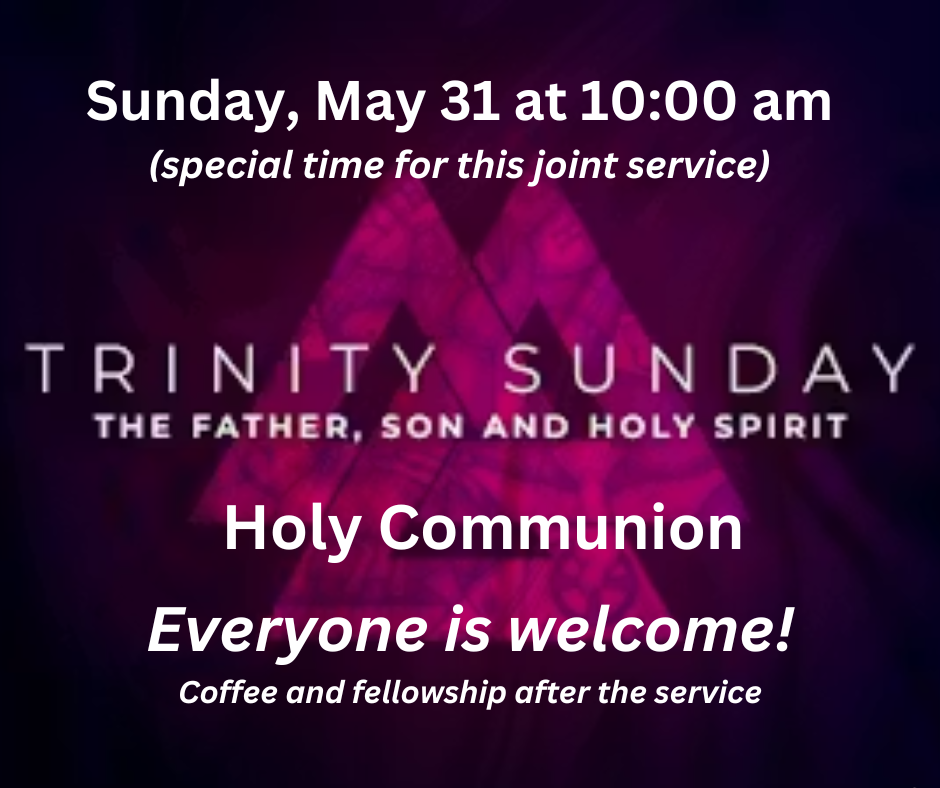
Trinity Sunday
Feast that celebrates “the one and equal glory” of Father, Son, and Holy Spirit, “in Trinity of Persons and in Unity of Being” (BCP, p. 380). It is celebrated on the first Sunday after Pentecost. Trinity Sunday is one of the seven principal feasts of the church year (BCP, p. 15). The proper readings and collect for Trinity Sunday are used only on the feast, not on the weekdays following. The numbered proper which corresponds most closely to the date of Trinity Sunday is used (BCP, p. 228). The BCP also provides the proper “Of the Holy Trinity” for optional use at other times, subject to the rules of the calendar of the church year (see BCP, pp. 251, 927). The Hymnal 1982 presents ten hymns in a section on The Holy Trinity (Hymns 362-371), including “Holy, holy, holy! Lord God Almighty!” (Hymn 362), “Come, thou almighty King” (Hymn 365), and “Holy Father, great Creator” (Hymn 368).
Celebration of Trinity Sunday was approved for the western church by Pope John XXII in 1334. This feast is associated with Thomas Becket (c. 1118-1170), who was consecrated bishop on Trinity Sunday, 1162. His martyrdom may have influenced the popularity of the feast in England and the custom of naming the remaining Sundays of the church year “Sundays after Trinity.” The Sarum Missal and editions of the Prayer Book through the 1928 BCP named these Sundays the Sundays after Trinity. The 1979 BCP identifies this portion of the church year as the season after Pentecost, and names these Sundays the Sundays after Pentecost (see BCP, p. 32)
Episcopal Church Glossary